Listing the same phone on Back Market and Refurbed doubles your reach. It also doubles the number of people who can buy it, and there is one of it. Everything difficult about multichannel inventory comes out of that sentence.
The short version
- Overselling is a timing problem, not a sync bug. One unit, two shop windows, and a gap in between.
- MARGIXA publishes what is sellable, which is a smaller number than what is on the shelf.
- A unit stops being available when the order is accepted, not when someone eventually packs it.
- A sale starts the update immediately. A sweep every minute catches anything the event missed.
Why one unit on two marketplaces is genuinely hard
Marketplaces do not ask permission before accepting an order. Two buyers can press buy on the same second for the same physical device, and neither platform has any way to know about the other. By the time anyone finds out there are two orders and one phone.
No software removes that. What software changes is the size of the window. If the new stock figure reaches both platforms within seconds, the overlap is a sliver and almost nothing falls into it. If it reaches them on a nightly export, the window is hours wide and your fastest movers will oversell every busy week.
This is the honest framing, and it is the one MARGIXA is built on: you are not trying to make the window zero, because you cannot. You are making it small, then holding enough buffer that the sliver which remains does not become a cancellation.
What gets published is sellable, not present
“How many do I have” and “how many can I sell” are different numbers, and publishing the first is the most common cause of the whole problem. Sitting between them:
- Units already sold but not yet shipped.
- Units on the bench, in quality control, waiting for a grade.
- Units in quarantine, in repair, or out on a supplier RMA.
- Units physically in the building but not yet put away, and so not findable by a picker.
Every one of those is a real device your warehouse can see and your listings must not. MARGIXA counts only what is ready for sale, subtracts what is reserved and what the buffer holds back, and publishes the remainder. The same number goes to every channel, because there is one pool and no per-channel allocations to reconcile.
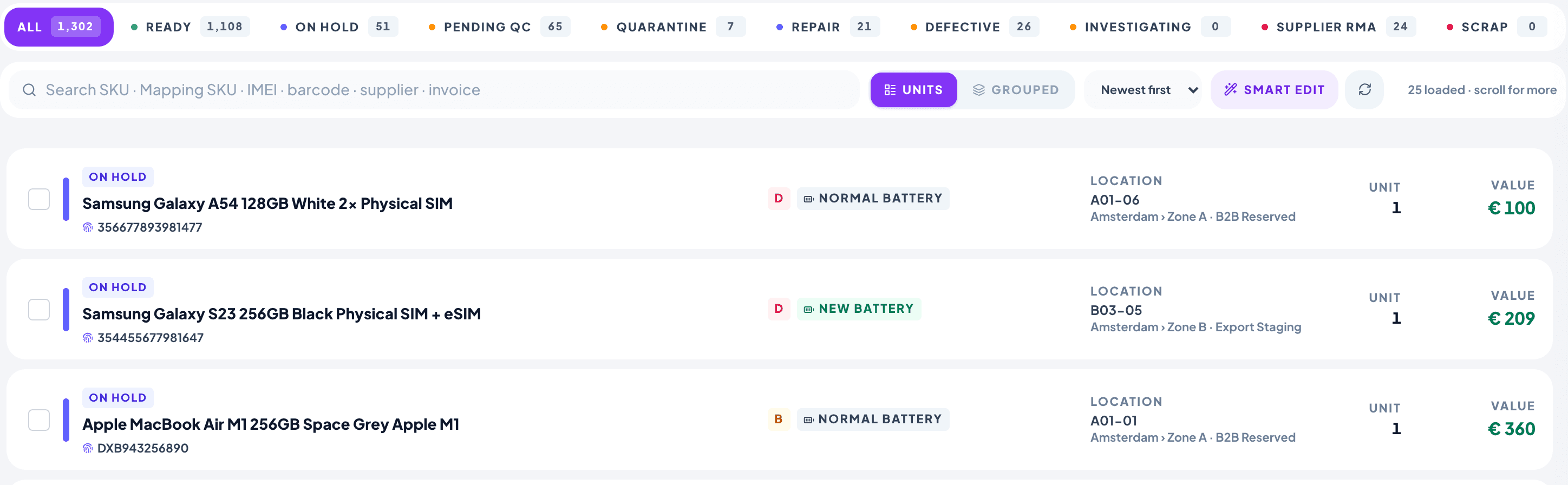
A unit stops being available at the order
This is the single decision that prevents most double-sells, and it is easy to get wrong. A system that removes stock at shipment will happily sell the same device several times while it waits in the pick queue, and the pick queue is exactly where units sit during the hours you are busiest.
In MARGIXA the moment an order is accepted, that unit is reserved and the published figure drops everywhere. Picking, packing and the label all happen afterwards, to a device that is already spoken for.
How fast the new number reaches the channels
Two mechanisms, deliberately, because one of them will eventually fail.
The event
Any change to sellable stock writes a row the moment it happens, and that row is picked up within seconds and pushed to every channel the SKU is mapped to. A sale starts the update. Nothing waits for a scheduled run.
The sweep
Once a minute, a second pass compares what the marketplaces are showing against what the pool says and fixes any difference. It exists for the cases the event missed: a network blip, a marketplace that was briefly unreachable, a change made in a way nobody anticipated.
The sweep is the part worth insisting on. An event-driven system with no safety net is fast until the day it silently is not, and stock drift never announces itself.
Only differences are sent. Most cycles end with the majority of listings at the quantity they already had, and pushing those anyway spends a marketplace’s rate allowance on nothing, which is how sellers end up throttled at the exact moment a real change needs to go through.
The safety buffer, sized per item
A buffer is stock you have but do not publish. It is not pessimism, it is the margin of error covering the window you cannot close. The mistake is picking one number for the whole catalogue.
| Item | Flat buffer of 2 | Buffer by velocity |
|---|---|---|
| Sells twice a month | Two units sitting unsold for no reason | Nearly nothing held back |
| Sells several times a day | Not enough to cover a Saturday | Real headroom, while it is needed |
| During a promotion | Unchanged, which is the problem | Widens, then relaxes afterwards |
A useful test: if your buffer never protects anything, it is too large. If you are cancelling orders, it is too small. In between, it should catch a handful of near-misses a month and you should never notice them.
When a count is wrong anyway
It will happen: a unit taken for parts, a counter sale nobody recorded, a device that went back to a supplier. The question then is not whether the number is wrong, it is how long it takes to find out why.
Every movement in MARGIXA is recorded against the individual unit, with what changed, when, and who did it. That turns “we are one short” from a quarterly stock count into a lookup. And when a whole shelf has drifted, the audit module counts a zone against the system and shows you the differences rather than asking you to trust either side.
Checklist
Before you list the same stock on a second marketplace
- One pool. Every channel reads from it, and nobody edits stock on a marketplace directly.
- Publish the sellable count, never the shelf count.
- Make sure QC, quarantine, repair, supplier RMA and put-away pending are all excluded.
- Reserve the unit when the order is accepted, not when it ships.
- A sale should start the push, with a periodic sweep as the safety net.
- Size the buffer per item, and widen it before a promotion rather than after.
- Review your grade mappings per marketplace when either side adds a condition.
- Keep a per-unit trail, so a wrong count is a lookup instead of a stock count.
See it in the demo. The video opens at one stock for every channel.
For the sharpest picture, open Settingsin the player, chooseQuality · 2160p (4K)and watch it full screen.
Questions we get asked
Can overselling be eliminated completely?
No, and anyone promising zero is selling you a sentence rather than a system. Two marketplaces can accept an order for the same unit in the same second, before either has heard of the other. What can be done is to make that window very small and to hold a buffer for the times it still lands.
Should I split my stock between the marketplaces instead?
It is the safe answer and usually the expensive one. Five units on each means either side can run dry while the other sits on unsold stock. One pool with a small buffer generally sells more, provided the pool is genuinely shared and updated in seconds rather than overnight.
How big should the buffer be?
As big as your reaction time multiplied by how fast that item sells. A model that moves twice a month needs almost nothing. A model that moves several times a day on both platforms during a sale week needs real headroom, and only during that week. MARGIXA can hold a fixed buffer or size it from the item’s own velocity.
What stops someone editing stock on the marketplace directly?
Nothing technical can, which is exactly why it is a rule rather than a feature. The moment a marketplace becomes a second place stock can be changed, the two disagree and you find out from a buyer. In MARGIXA the pool is the single place, and every channel reads from it.
Does a unit in repair or quarantine still show as available?
No. Only units that are ready for sale and not archived count toward what is published. Anything in quality control, in quarantine, in repair, on a supplier RMA or not yet put away is real stock your warehouse can see and your listings cannot.