At ten orders a week, invoicing by hand is fine. At a hundred a day it is a full-time role that produces nothing, and the mistakes it makes are the expensive kind: the wrong scheme, a gap in the numbering, a line that says the model rather than the device.
The short version
- The invoice is issued from the unit that actually shipped, so it identifies the device rather than the model.
- Your tax scheme is set once and can be overridden per marketplace, because the two rarely want the same one.
- On a regular-VAT sale the rate follows the buyer’s country. On a margin sale the VAT line is suppressed entirely.
- It reaches Back Market and Refurbed without anyone remembering to send it.
The job nobody wants, and why it grows
Invoicing is the part of the operation that scales worst. It costs nothing at low volume, it is boring, so it gets done last, and then it is a backlog. And a backlog of invoices is not just admin: it is buyer tickets, a support load, and a bookkeeping problem, because an invoice you never issued is a sale you cannot cleanly account for.
The version that scales does four things without being asked: issue at the right moment, from the right unit, under the right scheme, and deliver where it needs to go. Everything below is those four.
Issued from the unit that shipped
The invoice is generated when the order ships, from the record of the device that actually went in the box. Not from the order line, which knows the model, but from the unit, which knows its own identifier, its grade and what it cost you.
That matters in two places you will meet eventually:
- A buyer disputes which device they received. The invoice carries the serial of the one you sent.
- You need the margin on the sale. It comes from that unit’s purchase price, not an average for the model, so two identical phones bought months apart report honestly different numbers.
Numbering runs sequentially per company and per year, with no gaps to explain to anyone later, and the prefix is yours to set.
One company setting, overridden per marketplace
Second-hand electronics sellers do not run one tax scheme across everything, and a system that assumes they do forces a workaround within a week.
In MARGIXA the scheme is a company setting with four options, and each sales channel can override it. A merchant selling to consumers on one marketplace and to a mix of businesses and consumers on another commonly runs different schemes on each.
| Scheme | VAT line on the invoice | Typical use |
|---|---|---|
| Standard VAT | Rate and amount shown | Stock bought with a VAT invoice |
| Margin VAT | Suppressed · your legal wording printed instead | Second-hand goods under the margin scheme |
| Reverse charge | Suppressed · the reference printed instead | Cross-border B2B where the buyer accounts for it |
| VAT exempt | Suppressed | Where an exemption applies |
We build software, not tax advice. Which scheme applies to your stock is your accountant’s call. What MARGIXA guarantees is that once you and they have decided, every invoice comes out that way, including the ones issued at 2am by a process nobody is watching.
On a regular-VAT sale, the rate follows the buyer
Selling across the EU means the rate is not one number. MARGIXA resolves it from the buyer’s billing country using the rates you configure, and falls back to your standard rate when a country has no specific one.
On margin, exempt and reverse-charge sales the rate is never printed at all, because the template suppresses the line rather than rendering a zero. A zero VAT line and a suppressed VAT line look similar on screen and are not the same document.
Reaching the marketplace, not just the buyer
Producing the invoice is half the job. The other half is that it has to arrive, and on a marketplace that means going to the marketplace rather than only to an email address.
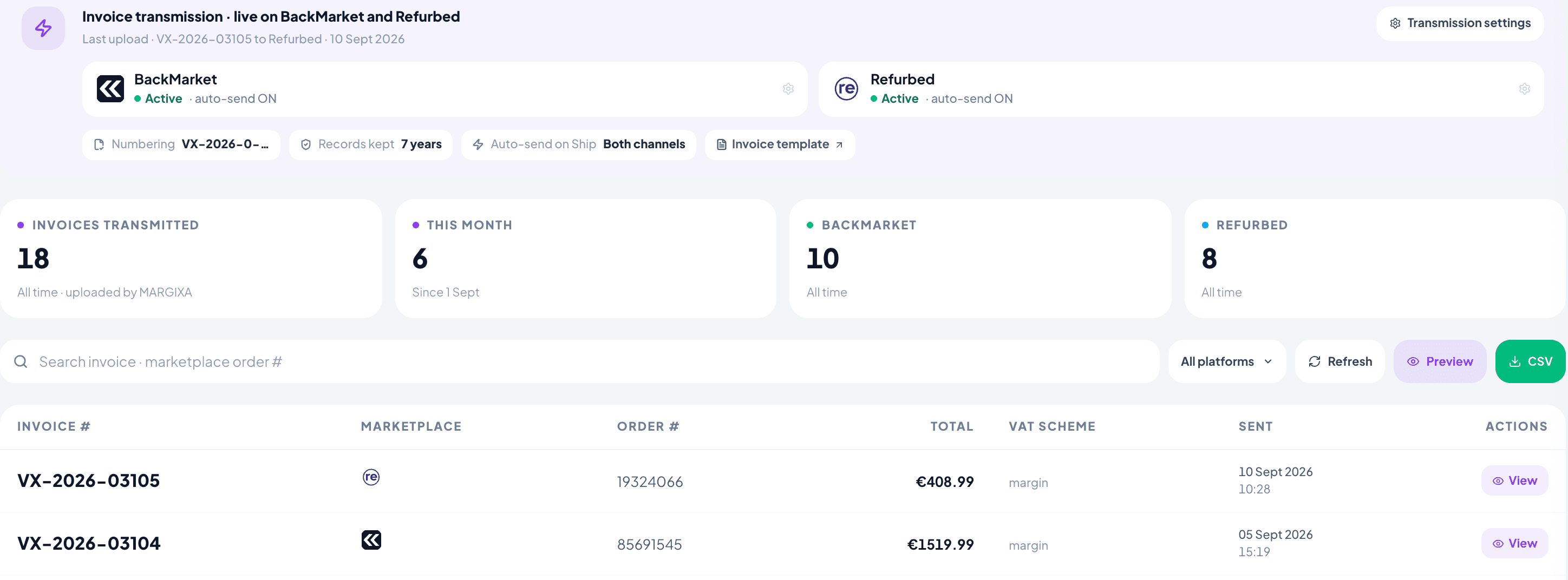
Each channel can be switched on independently, and the panel shows what was transmitted rather than what was merely generated. The distinction is not pedantic: a generated invoice that never reached the marketplace is exactly the case that produces a buyer ticket three weeks later, and it is invisible unless something counts it.
What is deliberately not stored
An obvious way to build this is to render every PDF and keep them all forever. MARGIXA does not, because that archive is a liability that grows every day and protects nobody.
What is kept is your side: the lines, the totals, the scheme, the numbering, the fingerprint of the document that was issued. The buyer’s details are fetched when a copy is actually needed and merged in at that moment. The invoice you re-download next year is the same document, and there is no warehouse of names and addresses to protect, export, or explain after a breach.
The strongest protection for buyer personal data is not storing it. Applied to invoicing that sounds like a constraint and is actually a simplification.
Checklist
Getting marketplace invoicing off a person’s desk
- Issue on ship, from the unit that shipped, not from the order line.
- Put the device’s identifier on the invoice.
- Set the company tax scheme once, then override it per marketplace where they differ.
- Configure per-country VAT rates for the countries you actually sell into.
- Check that margin and reverse-charge invoices suppress the VAT line rather than print a zero.
- Number sequentially per company and per year, with no gaps.
- Keep both the transaction currency and your base currency on the record.
- Watch what was transmitted per channel, not what was generated.
See it in the demo. The video opens at the tracking number and the invoice.
For the sharpest picture, open Settingsin the player, chooseQuality · 2160p (4K)and watch it full screen.
Questions we get asked
Can I use a different tax scheme per marketplace?
Yes, and it is a common setup. A merchant selling mostly to consumers on one marketplace and to a mix of businesses and consumers on another can run the margin scheme on the first and regular VAT on the second. Each channel carries its own override, and anything without one inherits your company default.
How is the VAT rate chosen on a regular-VAT sale?
From the buyer’s billing country, using the rate you set for that country, and falling back to your standard rate when there is no specific one. On margin, exempt and reverse-charge sales the template suppresses the VAT line entirely, so a rate is never printed where it does not belong.
Does the invoice show which device was sold?
Yes. It is issued from the unit that actually shipped, so it carries that unit’s identifier rather than a generic model line. That is what settles a dispute about which device a buyer received.
What if I sell in a currency other than my own?
The invoice carries the transaction currency and your books carry your base currency, converted at the rate that applied on the order date. Both are kept on the record, because keeping only one of them loses something you will eventually need.
Are the PDFs stored somewhere I have to protect?
No, and that is deliberate. What is kept is your side of the invoice: the lines, the totals, the numbering. The buyer’s details are merged in when a copy is generated, so there is no archive of names and addresses sitting around waiting to become a problem.