You buy a used iPhone from a consumer, refurbish it and sell it on a marketplace. There was no VAT on what you paid, so charging VAT on the full selling price would tax the same phone twice. The EU margin scheme exists for this case: the VAT is due on your margin, not on the whole price. It also changes what your invoice has to say.
Not tax advice
This guide explains the EU rules as they are written, with a link to each source. It is not tax advice. Whether the margin scheme applies to your stock, and the exact sentence your country wants, is a question for your accountant.
The short version
- Under the margin scheme, VAT is due on the difference between what you paid and what you sold for.
- It applies to second-hand goods bought from someone who charged no VAT you could deduct, such as a consumer, or another dealer selling under the same scheme.
- The invoice must not show the VAT separately, and must carry the margin scheme mention.
- The EU VAT Directive gives that mention in every EU language. The table is below.
What the margin scheme is
The rules sit in the EU VAT Directive (2006/112/EC), Articles 311 to 325. Three definitions do most of the work:
- Second-hand goodsare movable tangible property suitable for further use as it is or after repair (Article 311(1), point 1). Works of art, collectors’ items and antiques are defined separately, and precious metals and stones are left out.
- A taxable dealer is a business that buys such goods with a view to resale (Article 311(1), point 5). A refurbishing business that buys phones to sell them is the typical case.
- The taxable amount is the profit margin, less the VAT on that margin. The margin is the selling price minus the purchase price (Article 315).
A worked example
You buy a phone from a consumer for 300 euro and sell it for 400 euro. The margin is 100 euro, and the VAT is inside that 100, not added on top of the 400. With a VAT rate of 21 percent, the VAT is 21/121 of the margin, about 17.36 euro. If you sell at a loss, there is no VAT due on that sale, and, as the Dutch tax authority puts it, nothing to reclaim either.
When it applies, and when it does not
Article 314 lists who you must have bought the goods from, inside the EU, for the margin scheme to apply:
- a consumer or another person who is not a business for VAT;
- a business whose sale to you was exempt from VAT;
- a small business under the small-enterprise exemption, for capital goods;
- another dealer who sold to you under the margin scheme.
If you bought the phone from a wholesaler with a normal VAT invoice and deducted that VAT, the margin scheme does not apply to it and the sale goes under standard VAT. Many refurbishers end up with both kinds of stock. Article 319 also lets a dealer choose standard VAT for a sale that could go under the margin scheme, which matters when the buyer is a business that wants to reclaim VAT.
What a margin scheme invoice must say
Article 226 lists the details every VAT invoice in the EU carries, among them the date of issue, a sequential number, your VAT number, the full name and address of you and of the customer, and the quantity and nature of what you sold. A margin scheme invoice adds two rules:
- No separate VAT. Article 325: the dealer may not enter separately on the invoice the VAT on goods sold under the margin scheme. The buyer sees the price, not a VAT line.
- The mention.Article 226, point 14: where the scheme for second-hand goods is applied, the invoice carries the mention “Margin scheme - Second-hand goods”. That is the English text, and every language version of the Directive has its own words.
A business buyer cannot deduct VAT on goods bought under the margin scheme (Article 323). If your buyer is a company that wants to reclaim VAT, that sale needs a standard VAT invoice instead.
The mention in each language
Every language version of the Directive writes the mention of Article 226(14) in its own words. These are the mentions for second-hand goods, copied from the official texts on EUR-Lex. In most of them the two parts are separated by a long dash; the table shows a hyphen in its place.
| Language version | The mention for second-hand goods |
|---|---|
| English | Margin scheme - Second-hand goods |
| Dutch | Bijzondere regeling - gebruikte goederen |
| German | Gebrauchtgegenstände/Sonderregelung |
| French | Régime particulier - Biens d'occasion |
| Italian | regime del margine - beni di occasione |
| Spanish | Régimen especial - Bienes de ocasión |
| Portuguese | Regime da margem de lucro - Bens em segunda mão |
| Swedish | vinstmarginalbeskattning för begagnade varor |
| Danish | fortjenstmargenordning - brugte genstande |
| Polish | procedura marży - towary używane |
National law repeats or adds to this. Germany’s VAT act, for example, asks for the same words, “Gebrauchtgegenstände/Sonderregelung”, in § 14a(6) UStG. Agree the exact sentence with your accountant, and print the same one every time.
Selling to buyers in other EU countries
For most goods sold online to consumers in another EU country, VAT is due in the buyer’s country under the distance-selling rules of Article 33. Article 35 says those rules do not apply to second-hand goods taxed under the margin scheme. In plain terms, a margin scheme sale to a consumer elsewhere in the EU is generally taxed where the goods leave from, not where the buyer lives. How that fits your own VAT returns is, again, a question for your accountant.
Records to keep
The margin is selling price minus purchase price, so the purchase price has to be on record for every piece you sell. Where you use both schemes, Article 324 asks you to keep the two apart in your accounts. Countries add their own rules: the Dutch tax authority, for example, asks for a purchase statement (inkoopverklaring) when you buy for 500 euro or more from one supplier. Check the page of your own tax authority.
How MARGIXA prints a margin scheme invoice
In MARGIXA the VAT scheme is a setting of your workspace, and each marketplace can have its own. Choose Margin VAT and the invoice carries no VAT line, and the notes print the legal wording.
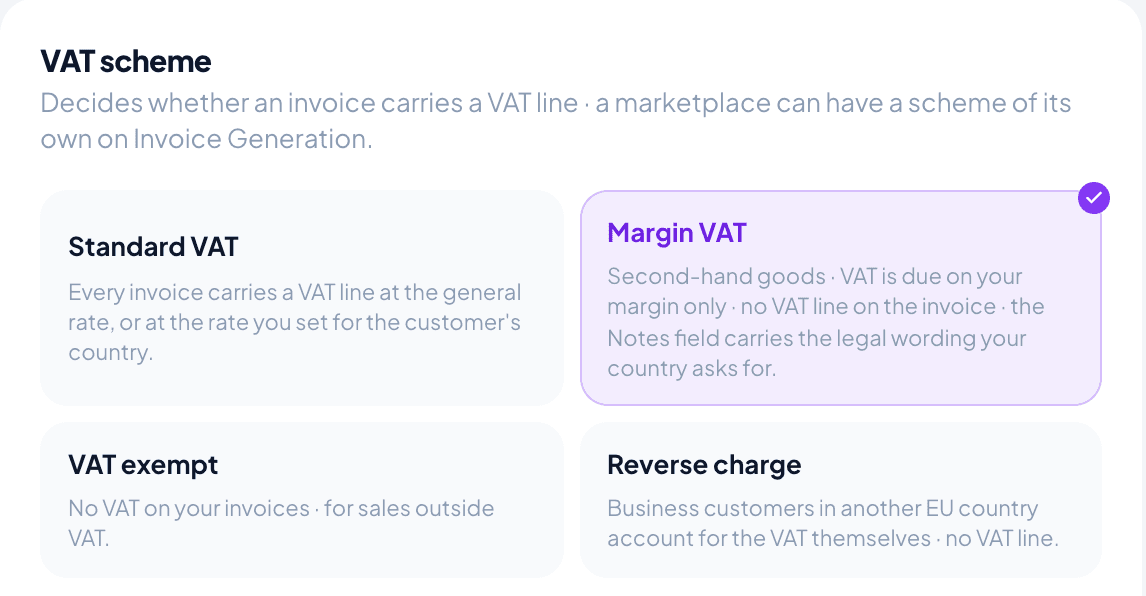
- Your sentence wins.Write the wording your accountant gave you, once, for every invoice or for one country. Where you wrote nothing, MARGIXA prints a standard sentence for the scheme and the buyer’s country, and the editor tells you it is MARGIXA’s.
- The buyer’s language, if you want it.With Invoices in the customer’s language on, the whole invoice follows the buyer’s country, in nine languages today.
- The purchase price per batch. Every batch you add carries the price paid per piece, the supplier and the invoice number, and stock leaves from the oldest batch first, so your reports carry what you really paid for what you sold.
- Sent on its own. On Back Market and Refurbed the invoice is uploaded to the order when it ships. How that works is in automatic invoices for Back Market and Refurbed.
Checklist
Before your first margin scheme invoice
- Know which of your stock was bought without deductible VAT, and which with it.
- Record the purchase price of every batch, with the supplier and the invoice number.
- Never show a VAT amount on a margin scheme invoice.
- Print the margin scheme mention in the language of the invoice.
- Use standard VAT for a business buyer who needs to reclaim VAT.
- Keep margin scheme and standard VAT sales apart in your accounts.
- Have your accountant confirm the exact sentence, then print it every time.
See what else MARGIXA does on the features page, or the platforms it connects to on the integrations page.
Sources
- EU VAT Directive 2006/112/EC, consolidated text (EUR-Lex) (opens in a new tab) · Articles 33, 35, 226, 311 to 325 · the other language versions are one click away on the same page
- Umsatzsteuergesetz § 14a (gesetze-im-internet.de) (opens in a new tab) · Paragraph 6: the mention Gebrauchtgegenstände/Sonderregelung
- Belastingdienst · Margeregeling (opens in a new tab) · No separate VAT on the invoice · a negative margin · the purchase statement
See it in the demo. The video opens at the margin scheme invoices.
For the sharpest picture, open Settingsin the player, chooseQuality · 2160p (4K)and watch it full screen.
Questions we get asked
Can a margin scheme invoice show the VAT amount?
No. Article 325 of the EU VAT Directive says a dealer may not show the VAT separately on invoices for goods sold under the margin scheme. The invoice shows the price and the margin scheme mention instead.
Does a refurbished phone count as second-hand goods?
The Directive defines second-hand goods as movable property suitable for further use as it is or after repair. A used phone that was repaired or refurbished usually fits that definition, but whether the margin scheme applies also depends on who you bought it from. Check your purchase with your accountant.
Can a business buyer reclaim VAT on a margin scheme invoice?
No. Under Article 323 a buyer may not deduct VAT on goods bought from a dealer under the margin scheme. A business buyer who needs to reclaim VAT needs an invoice under standard VAT.
Can I use the margin scheme and standard VAT side by side?
Yes. Article 319 lets a dealer apply standard VAT to a sale that could go under the margin scheme, and Article 324 asks a dealer who uses both to keep them apart in the accounts. In MARGIXA each marketplace can carry its own scheme.
What exact words should my invoice use?
Article 226(14) of the Directive gives the mention in every EU language, for example Bijzondere regeling - gebruikte goederen in Dutch and Gebrauchtgegenstände/Sonderregelung in German. Your country's law may ask for more, so let your accountant confirm the sentence you print.